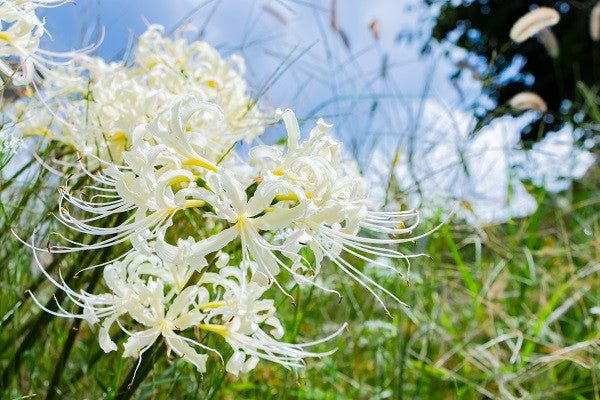
meaning of white spider lily White Spider Lily (Lycoris albiflora)
SKU: 2046065446
meaning of white spider lily

meaning of white spider lily White Spider Lily (Lycoris albiflora)

Sale price$19.28 Regular price$21.42
Save 10%

Pay in installments of $5.36 with ShopPay, AfterPay and Klarna

Shipping Estimate
USA
  • USA
  • CAN

Ships within 48 hours · Estimated delivery Jul 2 - Jul 7

Promo Codes Available:

For Your Every Summer RSVP, with Code: SUMMER15

Description

meaning of white spider lily White Spider Lily (Lycoris albiflora)Lycoris albiflora White Spider Lily We are offering these as plugs while supplies last! That means that we have started these, and they are ready to go into your garden especially now to take in nutrients because they have foliage. They will go dormant in another couple of months. So what are plugs? Lycoris plugs arent grown from seeds like most flowers. Instead, they come from tiny baby bulbs that were created using special plant science techniques.

Lycoris albiflora - White Spider Lily - We are offering these as plugs while supplies last! That means that we have started these, and they are ready to go into your garden especially now to take in nutrients because they have foliage. They will go dormant in another couple of months.

So what are plugs? Lycoris plugs aren’t grown from seeds like most flowers. Instead, they come from tiny baby bulbs that were created using special plant science techniques. Growers take a small piece of a healthy Lycoris bulb and encourage it to form new bulblets in a clean, carefully controlled environment. Once those baby bulbs develop roots, they’re grown in small plug trays — ready to be planted and grown into full-sized blooming bulbs.

So when you buy a Lycoris plug, you’re getting a young plant that started from a real Lycoris bulb, not a seed. It’s simply a smaller, earlier stage in the bulb’s life — just waiting to grow into those beautiful late-summer blooms. You will receive 12 plugs that already have the foliage up and growing so you know they are healthy.

So will they bloom in the fall of 2026?

It may take them a couple of years in the ground before they produce blooms. Like all Lycoris, when these bulbs bloom depends on how much sun and nutrients they absorb during the winter. To keep them happy:

  • Plant them in the ground for best results, spacing them close together.

  • Protect from freezes: If temperatures are expected to drop below 33°F, cover them with a bucket or frost cloth.

  • Healthy bulbs: You’ll know your plugs are strong because they arrive with their foliage already up — a sign they’re ready to grow!

With a little care, your Lycoris plugs will reward you with gorgeous late-summer blooms year after year.

The white spider lilies (Lycoris albiflora) are often seen blooming at the same time and in the same regions as the red spider lily (Lycoris radiata). In fact, they look very similar to the red spider lily, except that they are white! I first collected mine from a garden in Natchez, Mississippi where they seem to thrive. This garden belonged to one of the founding members of the Southern Garden History Society, but I am not sure where they originally obtained their bulbs.

How they bloom: White spider lilies bloom just like the red spider lilies - completely different from most "regular" flowers. Now is a perfect time to plant white spider lilies. Spider lily bulbs often need 1-2 years in the ground before they bloom so you are giving the white spider lilies that full year in the ground before they should pop up with a bloom on a naked stalk next September. White spider lilies usually take 1-2 years planted before presenting foliage or blooms. Your bulbs are developing a strong root system right now to support future foliage and eventually blooms. You might see the foliage this November - April, but don't be concerned if you don't.

Most people still expect to see something growing during the summer months. You won't see anything. These lilies are dormant in the summer. The flowers suddenly appear with the first later summer and early fall rains. One day there is nothing growing and then suddenly you have a surprise, a fully blooming flower! That is why they are called "Surprise lilies". They surprise you when they bloom because you didn't see anything growing just days before. White Spider lilies act very similarly to red spider lilies, yellow spider lilies, schoolhouse lilies, and naked ladies. Simply put, they bloom in the fall and then have foliage for the winter. Mr. Wiesinger has red spider lilies planted for almost 2 years that have not yet produced blooms but have produced increasing foliage each year.

Foliage: Let's talk foliage for a moment. We know that we all want to see the beautiful unusual blooms in the fall, but the foliage is very important. The foliage is what allows the bulb to grow and multiply. Many people get very concerned if they don't see the spider lily bloom the first year that they plant it and believe that maybe the bulb isn't any good. The foliage is what you watch for if you don't see your spider lily bloom, or even if you do. Even if the foliage gets hit by a winter cold snap, it will have taken in nutrients for months! Always allow the foliage to die down naturally and don't cut it off. If you cut it, you are killing the bulb. Once the foliage is completely dead which is usually around May, this area can be mowed. Remember, it takes a lot of energy for the bulb to push that bloom up out of the ground and open wide. The more time the bulbs can take in nutrients, the more energy they will have for that fall bloom.

Blooms: They should bloom in September after being the ground for a year. However, depending on the rainfall, they may skip a year. Once established in your garden they are there for a lifetime! Some say that the flowers bloom two weeks after the first good fall rain. If there is no rain during the month of September, the bulbs have been known to not bloom at all. Individual blooms aren't softball-sized but blooms together on a stalk are softball-sized. The spider lily foliage follows the flower, staying green well through the winter and into late spring. We have spider lilies that haven't bloomed for two years due to no rain, but we know that they are healthy because the foliage appears every fall and is multiplying. Is there anything that you imagine wouldn't look even more amazing next to these blooms?

Sun Requirements: The single most important thing about landscaping with spider lilies is the sun. They need at least 1/2 day of WINTER sun. That means about 6-8 hours of sunlight during the winter months. If you look at the photo above, you will see that they are in the shade of the trees. You can be sure that most, if not all, of those trees, will lose their leaves in the winter when the greenery needs sunlight. The spider lily puts on its foliage during the winter (November - May) and that is when it takes in the nutrients it needs to produce those striking white flowers the following September. The winter foliage soaks up sun energy during winter as it prepares for summer dormancy. The foliage normally completely dies down by around May.

Plant: For the plugs, you will plant them even with the soil. The foliage is already up!

Don't plant the bulb too deep. You will plant the bulbs 2-3 times deep the height of the bulb (so if your bulb is 1" tall, then you will plant it 2-3 inches deep). You can plant 2-3 per hole to make the blooms look more natural. White spider lilies really do well in any type of soil, but you may want to amend heavy clay soil. They thrive in soil that has plenty of organic material mixed in, but they do not require fertilizer. Newly planted bulbs would actually be harmed by exposure to fertilizer, so if you are going to apply nutrients, limit the application to established plants when the plants are producing their green leafy foliage during the winter. After planting the bulbs, water the soil thoroughly. Damp soil is ok, as long as the bulbs are in a spot where they will receive plenty of winter sun and the foliage is allowed to die down naturally in the spring. Standing water is not good. Once the summer season starts the white spider lily will do best in soil that dries out a little, as this facilitates its entry into the dormant stage when its leaves die back. The white spider lily doesn't like to be completely dry during the summer though. This period is followed by its blooming season when it will reward daily watering with long-lasting blooms. Too much moisture in the soil will lead to the bulbs rotting.

Multiplying and Dividing: The white spider lily multiplies with new bulb offsets quite readily. The absolute best time to divide the spider lilies is at the beginning of April, when the foliage has absorbed winter and early spring nutrients from the sun and the foliage dies back (turns a yellow-brown). Is this practical though? A much more practical answer on when to dig, divide, and transplant spider lilies is a familiar answer: when you have time! Yes, you really should not dig them in late fall after they just started to put out roots and grow foliage, but you can if you need to (like if you are moving, or a road expansion project is going to wipe out an old house garden with generations of heirloom flower bulbs). No matter what time you transplant spider lilies, whether it's the spring or fall, they often skip a year of bloom after being disrupted.

Other perennials to use with white spider lilies: I prefer to use some of the best blooming, toughest perennials to mix into our garden. At my home if I don’t use the best perennials, we will either kill them because they are not watered while we’re out of town, the kids will walk over them or pick them when they are about to bloom, etc. etc. So, I prefer to use any one of the following:
1) Salvias: There are many Salvia species that exist. You could choose the large fall blooming Salvia leucantha, an heirloom selection like Salvia ‘Henry Duelberg’, or a modern selection like Salvia x ‘Big Blue.’
2) Lantanas: the old orange and white selection is great, but also try Lantana ‘Gem Compact Pink Opal’ or some of the trailing lavender or purple varieties.
3) Plumbago: comes in a beautiful blue or white, although the white seems to be a little harder to keep alive.
4) Phlox: one of the best summer phlox that takes over in the hottest part of July is the Phlox ‘John Fanick.’ I can think of few better ways to cover dormant spider lilies than with this amazing phlox.

Other Annuals to use with white spider lilies: There are many summer perennials (and annuals for that matter) that can cover your dormant spider lily bulbs while they rest under the ground, so I am going to focus on cool season or winter annuals. The idea with cool season annuals is to find a companion plant that brings color to your garden when the bulbs are not in bloom. Personally, I prefer perennials due to budget and time reasons, but I am not opposed to going all in with annuals some years or for special events (like when we hosted a wedding shower one fall):
1) Alyssum: ‘White Stream’ is a popular selection. It is a cool weather selection that would last in spite of our hot summers.
2) Snapdragons: play around with many of the colors new varieties offer! They are just annuals, so have fun experimenting with varieties such as ‘Snapshot Pink’ or ‘Speedy Sonnet Yellow.’
3) Pansies: I’ll throw Viola (Johnny Jump Up) into the mix as well. They pack a lot of color into a small space and can carry the garden from fall through spring if there aren’t any hard freezes. They come in yellows, pinks, blues, purples, and more. Matrix is a popular selection of pansy.
4) Cyclamen: the red and white of cyclamen can be stunning. They are very popular in Houston and other climates that don’t normally experience hard freezes.
5) Paperwhites: I’ve included paperwhites along with the other annuals, because although they can be used as perennials in certain circumstances, in this circumstance you will want to remove them after they bloom. The answer to adding flowers to hide foliage is not MORE foliage for months after they bloom.

Still more bulbs to use with white spider lilies: There are an assortment of other perennial flower bulbs that go well with spider lilies. These are bulbs that will bloom during other seasons. Other Narcissus which bloom from January to March, as well as bulbs such as white iris, snowflakes, and rain lilies which carry the bulbs from winter through early spring. Other rain lilies, crinums, and Hymenocallis can then carry the bulb section of your garden through summer, and generally pair well with the other perennials.

Are White Spider Lilies deer resistant?

While deer will eat anything (including plastic flowers if hungry enough), spider lilies are more resistant to their urges than many other ornamental garden products. They definitely leave the foliage alone. So the answer to this question, is that they are mostly resistant, depending on how hungry the deer are. Remember, humans ate tulips during times of hunger/famine, yet tulips definitely aren’t on our menu either.

Shipping Notes
  • Free Standard Shipping on $100+ Orders to the USA.
  • Except Preorder products are shipped in 48 hours.
  • Delivery to the USA:
  1. Standard Shipping : 3-10 business days
  • If time is of the essence, please consider selecting expedited delivery for faster service.
Exchange/Return Notes
  • We offer a 30-day return/exchange service after receiving.
  • Final sale items are not eligible for returns or exchanges.
  • To process your return/exchange, please contact us at [email protected]
  • Please click here for more details>>> Return & Exchange Policy
SKU: 2046065446

Discover Niche Categories That Outsell meaning of white spider lily

Top-Converting Item to Boost Your Average Order

4.5 ★★★★★
Based on 940 reviews
Sort
Highest Rating
Newest First
Oldest First
Product Reviews
M
Verified Purchase
Muy Ben
Houston, US
★★★★★ 5
Best value/sound Sony Atmos Receiver especially w/2 Sony SW3 subs!!
Upgrading from 5.1 speakers on CNET's top AV 2014 receiver, the Sony STR-DN840, I was curious to see how far home theater sound had improved since buying my Sony receiver and Energy 5.1 speaker set up back in 2015. I first upgraded by adding 2 more speakers, the ELAC B6.2 Debut speakers as my front main speakers and moved my Energy speakers into a 7.1 height speaker configuration. This improved the sound, but only minimally. This is when I ordered this bad boy AN1000 as I also wanted to take advantage of Sony's S-Center Acoustic Speaker connection with my 77" Sony A80J OLED TV. The sound was marketedly better - so much so that my usually nonchalant wife noticed the trickles of streams and birds watching an old anime movie, Ponyo, and was impressed! Basically, the upgraded Sony STR-AN1000 coupled with two additional quality speakers enabled a 7.1 systems that leveraged DTS:X Virtual surround sound as well as A.F.D. Movie mode that comes as close to Dolby Atmos without placing speakers in the ceiling directly above your primary seating position. Watch the first battle/landing boat scene in "Saving Private Ryan", and prepare to be immersed with bullets whizzing all around you! Ignore sound bars and upfiring Atmos speakers that bounce off the ceiling as a quick online search will pull up numerous articles that state 1) Soundbars are inferior to AV systems (I can verify as I demoed a top of line Sony HT-A7000 at home) 2) upfiring Atmos speakers are hit or miss at best 3) Dolby's DTS:X combined with Sony's processor gives you the most immersive sound possible without installing downward firing ceiling Atmos speakers in a 5.1.2 Atmost configuration. Having my Sony Bravia A80J S-Center synch along with my center speaker made understanding dialogue much more clear, and also enabled me not to have to crank up the overall volume as the STR-AN1000 makes adjusting each individual speaker volume as well as sound profile (equalizer) super easy. I would also be remiss in not calling out the ability to either auto calibrate using the included microphone or manually calibrate as both are extremely easy to perform. I opted to do the manual calibration using a tape measure for greater precision, but the auto calibrate was quite good. Get this STR-AN1000 especially when on sale or open box, and not only will you be rewarded - even your wife will comment on how much immersive sound improvement there is on even non Dolby Atmos movies!! UPDATE: Purchased two Sony SW3 subs, here's an addenddum. Head to head, the Sony SW5 is superior to the SW3 thanks to the SW5's both active and passive subs which are also larger than the SW3. HOWEVER, especially when purchasing open box, I was able to purchase TWO SW3's for less than either stand alone SW5 or on sale single SW3, and 2 subs definitely not only smooth out the bass, but makes your home stereo/cinema sound omni directional so there's no dead spots. My Sony STR-AN1000 easily synced with both SW3 subs (note - you cannot mix two different subs on the AN1000), and now my bass is smooth/even throughout my living room as I watch Dolby Atmos movies or listen to my favorite music genre on my PS5 Playstation CDs, Pandora, and Sirius XM. Thus, if you only want one sub and best quality, go for the SW5 or a more reasonably priced wired sub. However, if you can get two subs, two SW3 are a no brainer especially when buying two heavily discounted open box speakers that can be readily tucked away.
WAS THIS REVIEW HELPFUL?YesReportShare
Reviewed in the United States on May 2, 2024
B
Verified Purchase
Bad Raptor
Massapequa, US
★★★★★ 4
Superb, Crisp Surround Sound. A few issues.
INSTALLATION AND CALIBRATION My previous Denon AVR which was older than 10 years did feature multi-channel sound separation but unfortunately may have had a capacitor fail because one of rear sound channels was no longer working and the AVR would go into a power-down/safe mode with flashing red power LED after a few minutes of use. Not really inclined to open the unit and attempt a self-repair involving soldering, I opted to upgrade the AVR to a newer Dolby Atmos-capable receiver, the Sony STR AN1000. Installing the AN1000 into my existing home theater set up was relatively easy, if you don’t account for crawling and stretching out on the living room wood floor and reconnecting existing speaker wire and subwoofer connections. Once the speakers were all connected, I used the calibration microphone and stand that comes with the AN1000 to establish the relative sound fields for each of the speakers. The graphical user interface from the Sony receiver to my Sony 4k TV was quite helpful in double-checking the accuracy of the calibration settings, which were slightly off in a few cases – particularly the distance of the subwoofers to the TV which for some reason added about 12 feet when they were only about 2 feet from the TV. When calibrating the unit, it is important to have a measuring device to verify the distance and height of all of your speakers, the height of your TV screen and the height of your ceiling. My home theater set up is in my living room and adjacent dining room that together have a 19-ft cathedral ceiling, so the acoustics can be quite pleasing. The other disconcerting thing about the graphical interface for the speaker setup was that it doesn’t give the user and option for smaller (bookshelf-sized) rear surrounds and only displays large speakers if your left and right surrounds are large. My front and side surrounds are large Sony tower speakers and given how my dining room is set up it doesn’t make sense to add additional tower speakers. CONNECTING AN APPLE TV 4K – Lack of the Dolby Vision Support I initially connected my AppleTV 4k set top box directly to the Sony AN1000 using an 8k-rated HDMI cable only to discover that the receiver would not pass through a Dolby Vision signal to the AppleTV 4k which display 4k SDR only. When I went online to see if this was a unique issue or whether other users had encountered this, I discovered that unfortunately this is a known issue that as far as I could tell that neither Sony nor Apple have yet to resolve. So, I was forced to reconnect the Apple TV 4k directly to the Sony TV once again. Sony claims to support Dolby Vision through the AN1000 but this is simply not the case unless there is a solution or work-around that they have published as of this writing that I have missed. DISPLAYING THE SOUND FIELD BEING USED The Sony AN1000 does have a nifty 360 Spatial Sound setting which comes in handy when watching older films whether they are streamed or from a Blu-ray player. That said whatever the current sound field being used is displayed on the front display panel of the receiver but is so small as to be unreadable especially considering that the user may be sitting some 10 feet away from the receiver and TV screen and not inclined to keep getting out of their chair to kneel down and get within a few inches of the receiver’s front display to see what the settings are. Attempting to verify the sound field by using the included Sony remote for the receiver is not much help since it hardly ever displays the information. Using the Sony TV’s remote isn’t much better since the option in the audio setting it displays is “Dolby Audio” not “Dolby Atmos” or “Dolby Digital Plus” or other sound fields/codecs like “DTS”. OVERALL PERFORMANCE - SOUND CLARITY AND SURROUND EFFECTS Despite some of the aforementioned annoying user interface issues, the surround sound effects of the AN1000 when in Dolby Atmos or using the Sony 360 Spatial Sound setting is quite impressive and to my ear sounds much crisper than my previous Denon multi-channel AVR. Initially my subwoofers were putting out probably a bit too much thundering low frequency bass; so, I actually had to reset the levels on them down a bit. This was quite noticeable when playing the 4k UHD Dolby Atmos stream of Blade Runner, for example and some other action films with explosions and other pyrotechnics. When playing the tornado scene from The Wizard of Oz, you really do get the sense that wind is whipping around you from every corner of the room. Other films that have been adept at incorporating Dolby Atmos will sometimes startle the viewer with offscreen sound effects that was made by another character that soon makes an appearance. Peter Jackson’s Lord of the Rings and The Hobbit trilogies are very good examples of this. I also tested the AN1000 with different genres (classical, opera, jazz, rock) of music on Amazon Music and was quite pleased with the crisp, clear sound of instruments and vocals. FINAL WORD To say that the AN1000 has horsepower and can create a dynamic and immersive theater sound experience in an averaged-sized living room is an understatement. This is a feature-rich and powerful home theater receiver and for most living room/family room/bonus room situations, the Sony STR AN1000 will be more than suitable for what you will need to create an entertaining surround sound environment.
WAS THIS REVIEW HELPFUL?YesReportShare
Reviewed in the United States on August 2, 2024
J
Verified Purchase
JoslinsROCK!!!
Charlottesville, US
★★★★★ 5
⭐️⭐️⭐️⭐️⭐️ I can see the stars and hear everything — this gazebo is now my favorite hangout spot! 😂
⭐️⭐️⭐️⭐️⭐️ I can see the stars and hear everything — this gazebo is now my favorite hangout spot! 😂 We set this outdoor gazebo up in the backyard and instantly it became the place to be. Whether we’re grilling, chilling, or hosting friends, this thing gives major outdoor-living vibes — like a backyard living room but without the weird couches. It’s spacious, sturdy, and feels like we basically just added a new room to the house… outdoors. The weather protection and shade are awesome — it keeps the sun off without making it feel like a cave, and when the breeze kicks in under the roof it’s chef’s-kiss perfect for summer evenings. We’ve got lights and music tucked under here, the whole patio feels like it finally has personality, and I swear we spend more time out here than in the living room now. If you want a backyard setup that says “party, relaxation, and maybe a nap later,” this gazebo delivers. Big enough for company, easy to decorate, and it makes every outdoor moment feel way more intentional — like you meant to create an oasis out there.
WAS THIS REVIEW HELPFUL?YesReportShare
Reviewed in the United States on February 23, 2026
B
Verified Purchase
B. Smith
Carnegie, US
★★★★★ 5
Glad I pulled the trigger on this.
I was researching many similar A/V Receivers and reviews for all were about the same I felt. Some would keep the first one they bought (around 1k range or less) and others would return them and buy a different brand that was in the price same range. I was able to buy this model for the cheaper price that has popped up at $565.94 (before tax). I read a review at Cnet Best AV Receivers for 2024. I normally use a grain of salt when reading reviews at sites like Cnet but since I couldn't find what I felt was a real end user consensus of go with this one not that one I then based my purchase off this line from the Cnet review "If you're spending under $1,000, there are four main receivers to choose from -- the Sony STR-AN1000, the Yamaha RX-V6A, the Onkyo TX-NR6100 and the Denon AVR-970H. All offer excellent performance, so the short answer about which to buy is whichever is available for the lowest price." That stuck with me since I did get this for cheaper than the Onkyo TX-NR6100 (a brand I would consider first). If I had more in my budget I might have gone with the more expensive Onkyo TX-RZ50 due to it's great reviews as well but this Sony STR-AN1000 does have a bunch of future proof features that I wanted. So far I am impressed with the Sony STR-AN1000 and have not seen any downside. I did pair this system with Klipsch Reference Series 5.2 Home Theater Pack with 2X R-625FA Floorstanding Speakers, R-52C Center Channel Speaker, 2X R-41M Bookshelf Speakers (as found on Amazon). That also comes with 1xReference R-12SW 12" Subwoofer. So far it has been great! Based on my research I would recommend you buy Oxygen Free Pure Copper wire instead of slightly cheaper 2 Core Parallel (Stranded CCA) Copper Clad Aluminum Wire Strands (for example). The cheaper ones that aren't pure Copper that may not deliver as well. That is going to be based on your own personal experience but I suggest spend once for something and not twice. I did not buy any banana clips to use with this receiver but I also forgot how much of a pain it can be unscrewing the caps and having to thread the speaker wire. SO I might suggest that if are on the fence about such a purchase. We only use Blu-ray or internet based streaming options with our setup through a Chromecast Ultra. I tested my Blu-ray of Ghostbusters Frozen Empire. The intro with the thunder and lightning could be felt and heard just like what I would expect in real life using this receiver and speaker setup. The system has no issue sending 2160p 4K HDR content through to the TV and of course the 5.1, Dolby Atoms, etc through as stated for support in documentation. I have not taken the system beyond a volume for 40 for testing different audio sources as I am breaking in the new speakers but the delivery really starts jumping up at about 34. I decided to switch from using sound bar systems to a full A/V Receiver and proper speaker setup due to sound bar systems underdelivering (even at the higher prices) or killing themselves due to trapped heat (I am talking about my personal experience with LG). Yes the initial cost is more but there is a difference between hearing what you are watching and experiencing it and longevity of product. I plan to keep this setup of mine for as long as possible and do not currently anticipate any need to replace short of conditions out of my control. I would recommend based on pricing or your personal preference of brands.
WAS THIS REVIEW HELPFUL?YesReportShare
Reviewed in the United States on June 21, 2024
M
Verified Purchase
Mauser
West Palm Beach, US
★★★★★ 3
TERRIBLE Home Theater AVR, Difficult to Use
TERRIBLE Home Theater AVR. I bought this based on the many very high level reviews and recommendations available on multiple sites. What a mistake. This unit is very difficult to use, and that is made even worse by Sony's BS proprietary insistence to not let their remotes work with any other brands of equipment except their own! After setup, I find there is no default input selection after startup of the AVR, not even the commonly seen default to the last used input. What this means is that EVERY TIME I want to use any audio or video unit with this AVR, I must first use the AVR remote to select the input, THEN put it down and find a different remote to use for whatever unit I want to watch. What a PAIN in the rear! The next totally unacceptable issue is that every time an input is changed, there are about 5 odd low-frequency thumps from the speakers - this has NEVER happened before with other AVRs and the same equipment, so this problem is very specif to this horrible amplifier. Other irritants are that the AVR display shows many almost meaningless things that are of no particular value, but they have removed ALL indications of what speakers are currently active for whatever input is being received. In addition to that, this AVR does not properly decode some input types that it is supposed to support (based on using format-specific test files). Another issue is that the input setting on my smart TV for this AVR does not stay Active while the TV is using a different input, despite the fact that the amplifier is always on, and the TV audio output IS constantly using the AVR for the speakers. This is somewhat related to the first problem I noted - since the TV does not think that the AVR is turned on, I cannot use the TV to select that input; I have to GO BACK to the nasty Sony remote just long enough to change inputs AGAIN, then put down that remote and switch to another. Again, I repeat that this behavior has NOT occurred with other AVRs tested in this Home Theater, only this one, and it makes life miserable. Even when I turn on a different connected device that uses HDMI Control to turn on the AVR, this brain-dead unit will NOT switch to that input after it powers on - I still have to manually make that switch with the Sony remote! Another issue is the inability to use a normal coax or balanced FM antenna input on this receiver - they give you a little single wire antenna that uses a strange miniature plug that is totally worthless in my area - cannot pick up a single station! And there is no way to connect my outdoor antenna like I have been able to do with every other receiver!!!!!
WAS THIS REVIEW HELPFUL?YesReportShare
Reviewed in the United States on July 21, 2025

recommand products